Life Learnings

We aren’t who we want to be

We aren’t who we want to be. We are what society demands. We are what our parents choose. We don’t want to disappoint anyone; we have a great need to be loved. So we smother the best in us. Gradually, the light of our dreams turns into the monster of our nightmares. They become things not done, possibilities not lived.” – Paulo Coelho

We Arent Who We Want To Be

All of us have been tuned to create pictures of ourselves in our own minds. Pictures of what we believe we are. We can wrap this idea around us as much as we want, but that will not make it true. The age-old question we are asked at every family gathering, every counselling session, every casual conversation is “What do you want to be when you grow up?” Mind you, this has nothing to do with the person you actually are. It’s a trick question. Most often the questioner is not really interested in your answer. He/She is just opening a door to seed your consciousness with his/her own thoughts. Thereby super-imposing your personality with a neat, presentable cover supposedly acceptable to society. You’re trapped.

You don’t want to disappoint anyone – parents, teachers, friends, your peer group. So you acquiesce – accept something reluctantly but without protest. And you gradually start believing it. The lie becomes your life. Now, your thoughts, actions, behaviour, everything starts adapting to this new perception which is being created for you. This persona you are creating is slowly suppressing your inherent self. Dimming that inner light which is so essential to present the reality to the outside world. You don’t move on enough. You stay because of reasons that are usually non-existent. You make up reasons why one cannot do something or go somewhere. Because your inner soul has been squashed. That voice has been silenced. Of course, one has responsibilities that cannot be easily abandoned, but those are not usually the things that keep us fixed in one spot. It is your belief, your idea about what it means, what is required of you, what is expected of you. Because, you don’t want to disappoint anyone.

Here’s where things can change. Must change. The good news is: You are whoever you choose to be.

It solely depends on how you choose to view yourself. Say, “I don’t want to care about the way other people perceive my lifestyle. I am what I am, I do what I do. End of story.”

No sooner have you uttered this magic mantra, the world completely turns around. Everything you thought to be true and necessary and wanted can be changed and discarded and thrown away. The truth is inside you. Awaken and find yourself. You do not need permission to be yourself. It’s your right to be who you want to be. It’s your mind, body and spirit, so how you use the three is your choice and your choice only. Once you become aware of this your inner voice can be assertive again. That inner light will start shining brighter. That is the light which you need to illuminate your path in this dark world. Nothing else.

Since, your self-perceptions were instilled before you had any say in the matter, learning to change how you see yourself helps find hidden strengths. Self-perception is simply being aware of who you are, what you’re like, and what you’re capable of. Your self-perception must project your positive self-esteem. But it should also acknowledge your shortcomings. Adjusting your self-perception is basically being honest with yourself. Recognizing your weak points helps you identify when you need to ask for help. Acknowledging your strengths gives you the confidence, if you feel down.

You can’t grow if you don’t try. You will have to actually plant the seed in your life. Nothing is holding you back except yourself. Unleash the possibilities to get things done. Opening your mind to new things means trying new things. Make it happen; don’t make excuses! Don’t restrict yourself. When you pre-fix ideas of what you’re “able” to do or not do, you have limited your opportunities. Open your world by unlatching this door and you can create, experience, feel, and learn.

All those things you considered impossible are simply so because you taught yourself to believe that. Whatever you believe you achieve, so do not let fear stand in the way of your desires. If you’ve been dying to do something, but you fear failure down the line, it’s time to let go of your fears and make your move right now. Just by taking action, you open your mind to new beliefs and possibilities. Fear should be what it really is – just another way of telling you to take action.

The time to be yourself is now, not next week or next year.


Categories: Life Learnings | Tags: , , , , , , , , , , , , , , , , , , | Leave a comment

Harsh Words, Deep Scars

We should try to avoid saying harsh words to loved ones and colleagues as they can leave scars on the mind. If necessary, be firm but polite. When seniors in office or elders speak rudely, we should try to stay silent or politely express our point of view. Ahimsa or non-violence means not injuring others in thought, word or deed.” – Pankaj Kumar

How many times have we heard, “Sticks and stones can break my bones but words can never hurt me”. Humbug! In truth, hurtful words can cause profound emotional harm. Recent research shows that people who were verbally abused as children grow up to be self-critical adults prone to depression and anxiety. Other people’s words have an incredible power to affect how we see and feel about ourselves. While positive words of encouragement can uplift and inspire us, negative words cut to the core and resonate over and over again.

To help people become happy, treat them the way you’d like to be treated yourself. Talk nicely. Don’t be mean. Sounds simple, but those are some of the most important things you can do.

Verbal abuse includes insults, swearing, threats of physical abuse and spiteful comments or behaviour. People may have learned this from their own parents or peers. But it is more likely they are simply not aware of positive ways to motivate. Verbal abuse is often overlooked and difficult to identify. Culturally, we don’t take the consequences seriously because the scars are not immediately visible and the victims are often so used to being treated in a certain manner that they do not seek help.

Over time, people begin to believe the negative things they hear about themselves and start to use those negative statements as explanations for everything that goes wrong. A pattern of self-criticism and negative thinking follows. In many cases, verbal aggression by people leads to physical aggression by the victims. The consequences of verbal abuse should not be underestimated. Physical abuse may leave actual scars but verbal abuse leaves invisible scars. The impact of verbal abuse on vulnerable, developing regions of the brain can have damaging effects that last a lifetime.

So why do people choose to abuse others? It’s all about power and control. In every healthy relationship, partners will try to build each other’s confidence. But emotionally controlling behaviour undermines their partner’s sense of self. The victims start to believe that they cannot cope, leading to become more dependent on the abuser.

A quick checklist can determine if you have someone who might be an abuser. More importantly, it can point to changes which you can make to avoid becoming one.

  1. Use words and attitudes to disrespect others?
  2. Persistently demand and retain control?
  3. Humiliate, criticize or shout?
  4. Treat others so badly that they are embarrassed amongst their peers?
  5. Ignore or put down others’ opinions or accomplishments?
  6. Blame others for their own abusive behaviour?
  7. See others as property or a sex object, rather than as a person?
  8. Treat others as though they are inferior?
  9. Manipulate?

Harsh Words Deep Scars

People should avoid yelling, demeaning, or otherwise acting in ways that erode confidence in their children, family, friends, colleagues. “Being a good parent is probably one of the most difficult jobs in the world, and one of the most important,” Dr. Sachs-Ericsson says. “A good childhood can last a lifetime.” Dealing with verbal abuse is simple. But it needs loads of patience and self-esteem.

  • Focus on positive attributes and actions. Convey your support and approval for them.
  • Smile and compliment them. Kill them with kindness! Keep your cool, then smile, and say something very nice in return to their comments.
  • In case of misdemeanours or mistakes, make it clear the behaviour is bad, but don’t deride or put down.
  • Whatever you do, don’t lose your temper! As feelings escalate, things might just spiral out of control before you even realize it. Keep your cool, and remember you can always let off steam at a convenient time later.
  • Be firm, yet polite. Be very clear about your requests and statements. Smile, and be polite, but stand firm. Then, follow through with your actions.
  • Read books and talk to other people to learn more effective man management skills.
  • Find support for yourself so you can better deal with the stress.

“Kindness and politeness are not overrated at all. They’re underused.” ~ Tommy Lee Jones

Categories: Life Learnings, Uncategorized | Tags: , , , , , , , , , , , , , , , | Leave a comment

Break From Work

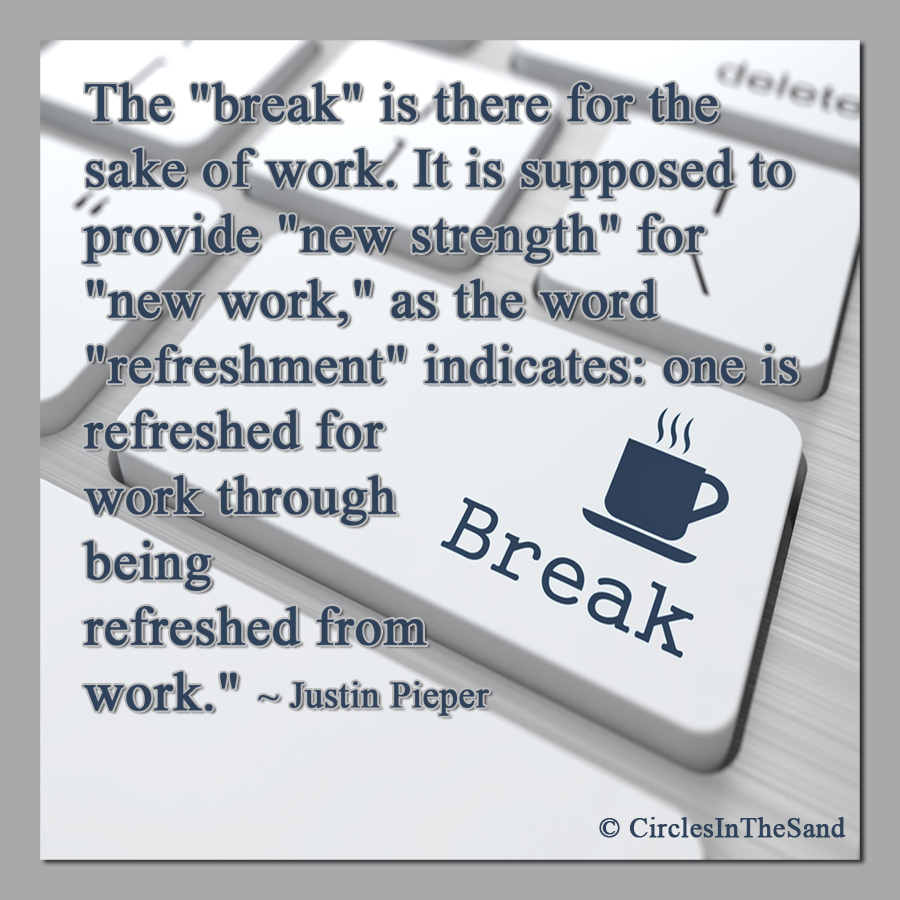
The simple “break” from work – the kind that lasts an hour, or the kind that lasts a week or longer – is part and parcel of daily working life. It is something that has been built into the whole working process, a part of the schedule. The “break” is there for the sake of work. It is supposed to provide “new strength” for “new work,” as the word “refreshment” indicates: one is refreshed for work through being refreshed from work.” ~ Justin Pieper

Each day as you head to work, ask yourself, “Am I having fun or learning today at work?” This simple question can help you stay motivated – as an employee, as a leader, while surrounding yourself with a comfortable aura – which off course you bring to work. When schedules are demanding, deadlines are looming, a sense of humor can help get the job done. But you could use a few tricks for keeping your focus.

Break From Work
Find time for creativity outside of the office. It could be a cultivating a hobby, pursuing an interest, planting in your garden, painting, reading for enjoyment (not work!), or just trying anything new. Taking breaks is the key. Sure, a vacation will recharge your batteries, but such luxuries may not by easily had or may be few and far between. The idea therefore is to accept that it will be fine to sometimes just take your mind off work and do nothing. When there’s something you truly enjoy, don’t feel guilty—just do it!

It’s important to realize that you cannot be on top of things all the time. There are going to be bad hair days too! At these times, try to ease off on yourself. Listen to others instead. Walk the halls, and talk to team members about mundane things – What they’re working on, How things are outside work, What the children have been up to. These loose thoughts may not throw up any new ideas but they will surely energize the mind. Listening is important, because we all run out of answers. Even after years of experience – an old dog can learn new tricks. Also, try complimenting someone. Praise gets returned in unknown and mysterious ways. When you take time to thank people for a good job or a great idea, it will immediately motivate you.

Lastly, and most importantly, motivation flags because you have lost sight of the goal. It is easy to fill our lives with trivial things while letting the end goal escape us. You may never find that perfect balance, but you should sort all of the major life issues into the correct pigeon holes. This will help you understand them better and therefore prepare suitable plans for action. You can call it a ‘life map’. Visually draw the paths you will take to reach your final goal. Understanding yourself is the best way to motivate.

Categories: Life Learnings | Tags: , , , , , , , , , , , , , | 2 Comments

Staying Young

“So curiosity, I think, is a really important aspect of staying young or youthful.” – Goldie Hawn

We aspire much, yet achieve little. Why? Our mind is rational and illogical, progressive and regressive, optimistic and pessimistic. Therefore and by nature it is incapable of a unified response. We need to deal with negativity and infuse positivity.

The first negative force is the tendency to create illusions and chase them. Understand the difference between goals and illusions. Goals are anchored in reality, while illusions derive from ego and wishful fantasies. Set up realistic goals, thereby multiplying the likelihood of their achievement. Aspire to be physically fit, emotionally vivacious, forever learning and evolving with age.

A second negative force is the pre-disposition to function in a conditioned manner. By the time we reach young adulthood, certain habits and personality traits have manifested themselves and they stick with us for the rest of our lives. Such habits restrict the range of what we can do and the variety of ways in which we can do them. This creates a comfort zone and defining it is our greatest blunder. It stops the natural ability of rejuvenation and healing which can be brought about by introducing new physical and mental activity. Your youth can be re-inforced by continuous interest in listening to, trying and practising anything different or new.

The third negative force is the tendency to think pessimistically. Life will throw painful experiences. You can decide to respond actively to take up the challenge. Your every thought and emotion sends a message to your immune system and this message can enhance or impair it. Positive emotions will boost the system whereas negativity will harm it. Happy and optimistic people live younger, longer.

Changing your mental attitude is the strongest step to staying young.

Curiosity Goldie Hawn

Categories: Life Learnings | Tags: , , , , , , , , , , , | Leave a comment

Lessons On Borrowing

5 important lessons for an individual borrower from the Greek crisis

5 Lessons Greek Crisis

Don't borrow what you can't repay:
The simple thumb rule to follow while taking any loan is: will the cumulative EMI of all your loans exceed 50% of your take-home salary? "If the answer is yes, you would be better off not borrowing. Being over-leveraged could result in just temporary ownership of objects of your desire; worse, you may have to part with your more valuable possessions too. When you are deep into loans, you may lose the items you really value due to the loans you took for items that could have been avoided.

Watch out for potential debt traps:
The future of Greece hinges on existing lenders continuing credit support. Many individuals too tend to borrow loans or use credit cards to repay existing loans. Being unsecured debt, personal loans charge a higher interest rate, which means that total dues will not shrink in a hurry. Worse, if you choose to pay just the minimum amount due on your credit card every month, you will avoid the defaulter tag, but you will get entangled further in the debt trap. In such cases, it's best to borrow against assets and clear the loans.

Don't be too optimistic:
Although, hefty pay packages are the norm in several sectors today, even in the mid and junior levels, overconfidence can be your Achilles' heel, jeopardising your financial plans. It's best not borrow on the basis of your estimation of future income and career prospects. Many take loans in anticipation of an increment or a job switch that will yield better salary. They could land in trouble if things do not go as per plan.

Keep tabs on credit history:
Credit scores are part of the loan eligibility evaluation process. Issued by several rating agencies, credit reports constitute a record of your loans and repayment track record. You need to monitor your credit profile by obtaining the reports from these companies, or at least before applying for a loan.

Live within your means:
Nobody has ever landed in trouble for being conservative when it comes to spending. Impulse purchases offer momentary pleasure, but a cause a lot of pain when the credit card bill lands. If the latest gadget means using your credit card without adequate money in your account to pay the bill, resist the temptation—you will thank yourself later.

Categories: Life Learnings | Tags: , , , | Leave a comment

Real Learning

If we’re going to solve the problem of indoctrination in our school system, we have to learn to begin asking questions instead of giving answers. Real learning is achieved through the investigative process. Children have to be encouraged to search for the answers themselves. It is up to the teachers to provide the tools and resources necessary for the children to conduct these inquiries and make meaningful discoveries. One well-formed question will do more to inspire than any number of answers. In every facet of our educational pursuits, it becomes crucial to begin an open dialogue with our students, to encourage healthy debate and to have them form their own conclusions.

The only person who is educated is the one who has learned how to learn and change.” – Carl Rogers

Instead of being an army style march to marks, we need to feel the joy of learning. A game with ideas and questions being thrown at each other like a ball in a park. The teacher’s role becomes a trigger. We end up doing more – with challenges and games and resources freely shared and used more intensely. The changed attitude is about deeper engagement with the content. Focus on the basics, even in higher classes. Do not assume that students know what they are should. Embed reinforcements of prior learning in every piece of work that is set for students. If they get the basics of reading, writing and arithmetic right, they are well placed to branch off on their own in later years. Instill confidence and competence in skills of speaking, debating, creating a structured argument and applying their learning to life.Educated
Categories: Life Learnings | Tags: , , , , , , , , | Leave a comment

The Bigger The Mistake, The Bigger The Opportunity

The Bigger The Mistake

We waste a lot of time and energy – first in trying not to make mistakes, then in trying to hide the mistakes we make, and finally in feeling guilty about these mistakes, either beating ourselves up or allowing someone else to do so. All this energy is completely wasted. One cannot live this life without making mistakes. It’s simply not possible. One also cannot hide mistakes indefinitely. It’s possible to get away once in a while, but sooner or later, one would be caught. Feeling guilty about a mistake does absolutely nothing but prevent one from actually fixing anything. Continually wallowing in such guilt paralyzes any actions to move forward. A person in such a condition is not able to be productive or solve problems.

We are all human. We all make mistakes. Some of us make lots of mistakes. Some of us make the same mistakes over and over and over. Some of our mistakes can have long-lasting, possibly permanent, consequences. Some of the consequences of our mistakes affect many people, not just ourselves. We need to simply accept those as the facts. Accept that you will make mistakes. That’s just the way it is.

When you see that you have made a mistake, just admit it. Admit it to yourself and to as many other people as were involved. Apologize to anyone you may have hurt, including yourself. Forgive yourself both for having made the mistake and for the consequences it brought you. Make a plan to try not to repeat that mistake in the future. Pause and reflect on what you learned through the experience. Open your mind to the possibility that your mistake may actually have benefited you in unexpected ways. Accept that you may end up getting opportunities that you never had.

Do not wallow in your mistakes. Do not grovel and prostrate yourself in hopes of forgiveness. We all make mistakes. Apologize and move forward. Do not replay the event in your head. Do not continue to beat yourself up. Do not profusely explain, defend yourself, make excuses or blame. After you apologize, do no more explaining; never explain more than once — ever. When you keep explaining and rehashing you just keep your mistake alive. Learn your lesson and adjust your behavior and move forward. Let people see you overcoming your mistakes with integrity. Most mistakes that seem huge in the heat of the moment are quickly forgotten. We often even further bond with others through surviving our mistakes together. Big mistakes are an outstanding opportunity to showcase your ability to recover and have grace under pressure. The bigger the mistake, the bigger the opportunity. This is how you turn it all around.” ~ Bryant McGill

Categories: Life Learnings | Tags: , , , , , , , , , , | Leave a comment

Should ? Must !

Does what goes on inside show on the outside?,” young Vincent van Gogh despaired in a moving letter to his brother while floundering to find his purpose. “Someone has a great fire in his soul and nobody ever comes to warm themselves at it, and passers-by see nothing but a little smoke at the top of the chimney.

And yet every day, countless hearths and hearts grow ashen in cubicles around the world as we succumb to the all too human tendency toward choosing what we should be doing in order to make a living over what we must do in order to feel alive.
Should is how other people want us to live our lives. It’s all of the expectations that others layer upon us. Sometimes, Shoulds are small, seemingly innocuous, and easily accommodated. “You should listen to that song,” for example. At other times, Shoulds are highly influential systems of thought that pressure and, at their most destructive, coerce us to live our lives differently. Echoing Eleanor Roosevelt’s famous admonition – “When you adopt the standards and the values of someone else … you surrender your own integrity,  …. become, to the extent of your surrender, less of a human being.”

Must is different. Must is who we are, what we believe, and what we do when we are alone with our truest, most authentic self. It’s that which calls to us most deeply. It’s our convictions, our passions, our deepest held urges and desires – unavoidable, undeniable, and inexplicable. Unlike Should, Must doesn’t accept compromises. Must is when we stop conforming to other people’s ideals and start connecting to our own – and this allows us to cultivate our full potential as individuals. To choose Must is to say yes to hard work and constant effort, to say yes to a journey without a road map or guarantees, and in so doing, to say yes to what Joseph Campbell called “the experience of being alive, so that our life experiences on the purely physical plane will have resonance within our innermost being and reality, so that we actually feel the rapture of being alive.”

One of the most common ways in which we imprison ourselves is by comparing ourselves to others. Finding our situation inferior we tend to blame first – the circumstances that we feel were unfair, then the people we believe were responsible for those circumstances, or some abstract element of fate we think was at play. The catch is that we end up judging our circumstances against others’ outcomes, forgetting that hard work and hard choices are responsible for the metamorphosis from circumstance to outcome.

If you want to know Must, get to know Should. This is hard work. Really hard work. We unconsciously imprison ourselves to avoid our most primal fears. We choose Should because choosing Must is terrifying, incomprehensible. Our prison is constructed from a lifetime of Shoulds, the world of choices we’ve unwittingly agreed to, the walls that alienate us from our truest, most authentic selves. Should is the doorkeeper to Must. And just as you create your prison, you can set yourself free.
Categories: Life Learnings | Tags: , , , , , | Leave a comment

Calmness – Will Bring Success

“The more tranquil a man becomes, the greater is his success, his influence, his power for good. Calmness of mind is one of the beautiful jewels of wisdom.” – James Allen

The ability to manage your emotions and remain calm under pressure has a direct link to your performance. Research shows that 90% of top performers are skilled at managing their emotions in times of stress in order to remain calm and in control. Research also shows the havoc stress can wreak on one’s physical and mental health. The thing about stress is that it’s an absolutely necessary emotion. Our system is designed in such a way that it will not take action until we feel at least some level of this emotional state. Performance will be effective under moderate levels of stress. As long as the stress isn’t prolonged, it’s harmless.

Hence, it is important to keep stress under control. Besides increasing your risk of heart disease, depression, and obesity, stress decreases your performance. Fortunately, though, unless you are being chased by a tiger, most of your stress is subjective and can be controlled. There are a few tricks to coping with stress – strategies employed by successful people. Or looking at it another way – people who manage and control their stress levels to enhance their productivity and performance are more successful.

When one begins to talk about them, some of these strategies seem obvious. The real challenge, therefore, lies in recognizing when you need to use them.

Appreciation – What You Have
Take time to contemplate what you’re grateful for. Not because it is right. This improves your mood and it reduces the stress producing hormones. Cultivate an attitude of gratitude and you will experience improvement in your mood, your energy, and your physical well-being.

Avoiding – What If ?
“What if ?” statements create suspicion. They cast aspersions on your confidence levels. And they fuel stress and anxiety. Of course, things will go in different directions. Things can always go wrong. But more the time spent worrying about possibilities, means the lesser you have to focus on taking the actions that will calm you down and keep your stress under control. Calm people know that asking “what if? will only take them to a place they don’t want – or need – to go.

Generating – Positive Thoughts
The biggest cliché. Easier said than done. Positive thoughts help. We know it. The idea is to make your brain generate positive thoughts. Give your wandering brain a little help by consciously selecting something positive to think about. Any positive thought will stabilize your attention. When things are going well, and your mood is good, this is relatively easy. When things are going poorly, and your mind is flooded with negative thoughts, this can be a challenge. In such moments, think about your day and identify one positive thing that happened, no matter how small. If you can’t think of something from the current day, reflect on the previous day or even the previous week. Or you can look forward to an exciting event. The point here is that you must have something positive that you’re ready to shift your attention to when your thoughts turn negative.

Detaching – Refresh Your Mind
Taking regular time off the grid can help keep your stress under control. To make yourself available 24/7 – to your work – only exposes your to a constant barrage of stress inducements. Forcing yourself offline – simply turning off your phone – can give your body a break from continuous stress. Even an email break can help control stress levels. We know that technology is extremely intrusive. There is constant communication and the expectation that you should be available all the time. It is extremely difficult to enjoy a stress-free moment outside of work when an email that will change your train of thought and get you thinking (read: stressing) about work can drop onto your phone at any moment. Detaching yourself from work-related communication is a must. When and how depends on you. Choose blocks of time where you cut the cord and go offline. You will be amazed at how refreshing these breaks are and how they reduce stress by putting a mental recharge into your schedule. In fact, not worrying about any negative repercussions this could have is the first step to controlling stress.

Reducing – Intake Of Stimulants
This is not a laughing matter. Coffee breaks can be stimulating. More because the caffeine actually releases adrenaline. Adrenaline is the source of the “fight-or-flight” response, a survival mechanism that forces you to stand up and fight or run for the hills when faced with a threat. This response avoids rational thinking. Of course, it’s great if you are being chased by a tiger, but not so good when all you need to do is calm down and respond to a not-so-nice email. The caffeine puts your brain and body into a hyper-active state and the stress that is created takes a toll on your system.

Sleeping – And Sleeping Well
One cannot say enough about the importance of sleep to increasing your emotional intelligence and managing your stress levels. When you sleep, your brain literally recharges, shuffling through the day’s memories and storing or discarding them (which incidentally, causes dreams), so that you wake up alert and clear-headed. Your self-control, attention, and memory are all reduced when you don’t get enough sleep. Sleep deprivation raises stress hormone levels on its own. Taking the time to get a decent night’s sleep is often the one thing keeping you from getting things under control.

Erasing – Negative Self-Talk
Most of our negative thoughts are just that – thoughts, not facts. When you find yourself believing the negative and pessimistic things, call on your inner voice to stop and write them down. Literally stop what you’re doing and write down what you’re thinking. Once you’ve taken a moment to slow down the negative momentum of your thoughts, you will be more rational and clear-headed in evaluating them. Using words like “never,” “worst,” “ever,” etc., cannot be true. Still, should you feel your statements look like facts, take them to a friend or colleague you trust and seek a second opinion. Then the truth will surely come out. When it feels like something always or never happens, this is just your brain’s natural threat tendency inflating the perceived severity of an event. Identifying and labeling your thoughts as thoughts by separating them from the facts will help you escape the cycle of negativity and move toward a positive outlook.

Redefining – Your Perspective
Stress and anxiety are fueled by our perception of events. It’s easy to think that unrealistic deadlines, unforgiving bosses, and out-of-control traffic are the reasons we’re so stressed all the time. You can’t control your circumstances, but you can control how you respond to them. So, take a minute to put the situation in perspective. If you’re thinking in broad, sweeping statements such as “Everything is going wrong” or “Nothing will work out,” then you need to redefine the situation. To correct this unproductive thought pattern, list the specific things that actually are going wrong or not working out. Most likely you will come up with some simple things – definitely not everything – and the scope of your stress will look far more manageable.

Breathing – Practice It
By far the easiest way to deal with stress – and something you have to do anyway – breathing. The practice of being with your breath will induce your brain to focus solely on the task at hand. (This is also called Meditation and there are many simple techniques to practice – dealt with more extensively – elsewhere in this blog). When you’re feeling stressed, focus on your breathing. You will notice an abnormality. A heaviness, an increased pace. So, put aside all distractions, sit in your chair, close your eyes and just breathe. The goal is to spend the entire time focused only on your breath – to prevent your mind from wandering. Think about how it feels to breathe in and out. This task may seem too easy or even a little silly, but it is the one thing with guaranteed results.

Developing – A Support System
Attempting to tackle everything by yourself may be tempting, but could be quite disastrous. To be really productive, you need to understand your weaknesses and seek help when you need it. This means you should have a support system. Identify friends, colleagues, any individuals in your life whom you can trust. Seek their insight and assistance when you need it. Talking about your worries will provide an outlet for your anxiety and stress. At the same time, the replies in this conversation will provide the new perspective you need. This is because doing the same thing and looking at the problem from the same angle causes ‘operational blindness’. Other people can see solutions that you can’t because they are not emotionally involved with the problem.

Categories: Life Learnings | Tags: , , , , , , , , , , | Leave a comment

Sadness – The Key To Happiness !

Believe it or not, Sadness – the opposite of Happiness – itself is the key to happiness. It sparks a new meaning and purpose in our life. Though it seems like the end of the road, but the truth is that it generally proves to be the beginning of another road. Therefore, even if you feel caught up in a situation when nothing strikes your mind, and you find yourself standing in the middle of nowhere, you must not lose hope. Let’s see how we can go there ….

Start Each Day With A New Hope
“Negativity is the enemy of creativity.” – David Lynch.

Begin each day with a feeling of gratitude and don’t let negative thoughts make your day begin on a sad note. Convince yourself that today is going to be a beautiful day. Creativity prospers under happy conditions and diminishes under sad ones. Negativity perpetuates itself, breeds dissatisfaction and clutters the mind.  And when the mind is already cluttered with negativity there will be no space for creativity.
Do What You Are Passionate About
“Do what you love and you will never work a day in your life’’ – Marc Antony.

People are not happy with their life because their jobs do not satisfy them. So do a job that gives a feeling of fulfilment. Improve the quality of your life. Make a list of the top things you like to do in your spare time. Don’t include necessary household duties like grocery shopping. List all your favorite things – like reading, walking in the park or painting. Having an understanding of the types of activities that you enjoy will help you incorporate them and find a job you’re passionate about.

Work on Yourself
“Strive for continuous improvement, instead of perfection.” – Kim Collins.

No one is perfect and there is always scope for improvement. Work towards your goals and dreams by introducing changes in yourself. This can and should include imparting knowledge and sharing your craft with others. A culture of continuous improvement is one in which individuals are growing, learning and contributing to the overall goal. Identify your weaknesses, strengthen these with training. Ask and answer questions. Give yourself room for experimentation and allow yourself to make mistakes. Making, recognizing and rectifying mistakes is the true training ground for continuous improvement.

Revitalize your body
“Yoga is a way to freedom. By its constant practice, we can free ourselves from fear, anguish and loneliness.” – Indra Devi
Amidst the hustle and bustle of trying to have a perfect life, we often tend to lose focus on our body. So, every morning, spend at least 10 minutes indulging in some form of exercise – simple yoga can help stretch your body and prepare your mind for the day ahead. Exercising in the morning is a great way to start your day. It gets you pumped and lets your body release “happy chemicals” – endorphins. Exposure to the morning light triggers your biological clock. Exercise floods your body systems – which have been sleeping – with energy and brings the feeling of ‘freshness’. Concentration on the exercise regimen can de-clutter the mind allowing space for new thoughts and creative ideas.

Listen to Music
“Music can change the world because it can change people.” – Bono

Music has a magical effect on our body when it comes to relieving stress. It has been proven to change our moods.  This is why shoppers use it, and why therapists also recommend it. The smooth melody and soothing harmony just washes all one’s worries away. Music not only helps you to relax, it focuses the mind and improves concentration. According to some theories, studying with music, makes you smarter! And it inspires those lacking in hope. So, plug in your earphones and tune into a soothing song, letting yourself loose. The simple activity will energize your senses and make you feel on top of the world.

Give Someone A Hug
“I have learned that there is more power in a good strong hug than in a thousand meaningful words.” – Ann Hood

Everybody likes to get a hug once in a while. It’ll make both of you feel good. Know that what you are going through is very common. The simplest human touch when one is not expecting it, or even when one is expecting it, can deliver such joy and contentment. A hug is a step up, and so many of us don’t meet our daily hug quota. Hugging builds stronger bonds with the people you see everyday. It lowers stress – releasing cortisol in the body. It will turn a bad mood upside down.  Hugging reconnects the mind with the body. When chaos builds – which it does rapidly in the workplace, behind the wheel, while on the computer – a good hug can reconnect us to that idea of conscious existence. A good hug has the power to prompt us towards better posture, deeper breathing, and a more relaxed state of being.

Talk To Someone
“I enjoy being around people. I also love talking to people – which is why I think I did so well.” – Kevin Hart

Talk to someone you trust about what you are feeling – they can help you sort through your emotions. Sharing your feelings helps, especially when your feelings are not so good. It can be really hard not to tell anyone that you’re feeling sad, worried, or upset. Then, it’s just you and these bad feelings. If you keep feelings locked inside, it will make you sick. But when you talk with someone who cares for you – like your mom or dad – you will almost always start to feel better. Now you’re not all alone with your problems or worries. It doesn’t mean your problems and worries magically disappear, but at least someone else knows what’s bothering you and can help you find solutions. Sometimes you need help. And if you do, talking about your feelings can be the first step toward getting it.

Keep Working Towards your Goal
“Setting a goal is not the main thing. It is deciding how you will go about achieving it and staying with that plan.” – Tom Landry

People who sit back and wait for something to happen are usually the ones who do not achieve anything in life. Once you have it all figured out in life, start working towards it. Don’t wait for someone to do it for you. Get down to the basics. Be specific about what you want to achieve. The, draw up a plan of action, listing the steps. Read and listen to advice. Re-assess your goals and your achievement status. When you feel that you are lagging, research alternative plans. Visualize and focus on your goal. And above all, take action. Don’t just ‘be in motion’, Motion is when you’re busy doing something, but that task will never produce an outcome by itself. Action, on the other hand, is the type of behavior that will get you a result.
Categories: Life Learnings | Tags: , , , , , , , , , | Leave a comment

Blog at WordPress.com.